Monday, April 5, 2021

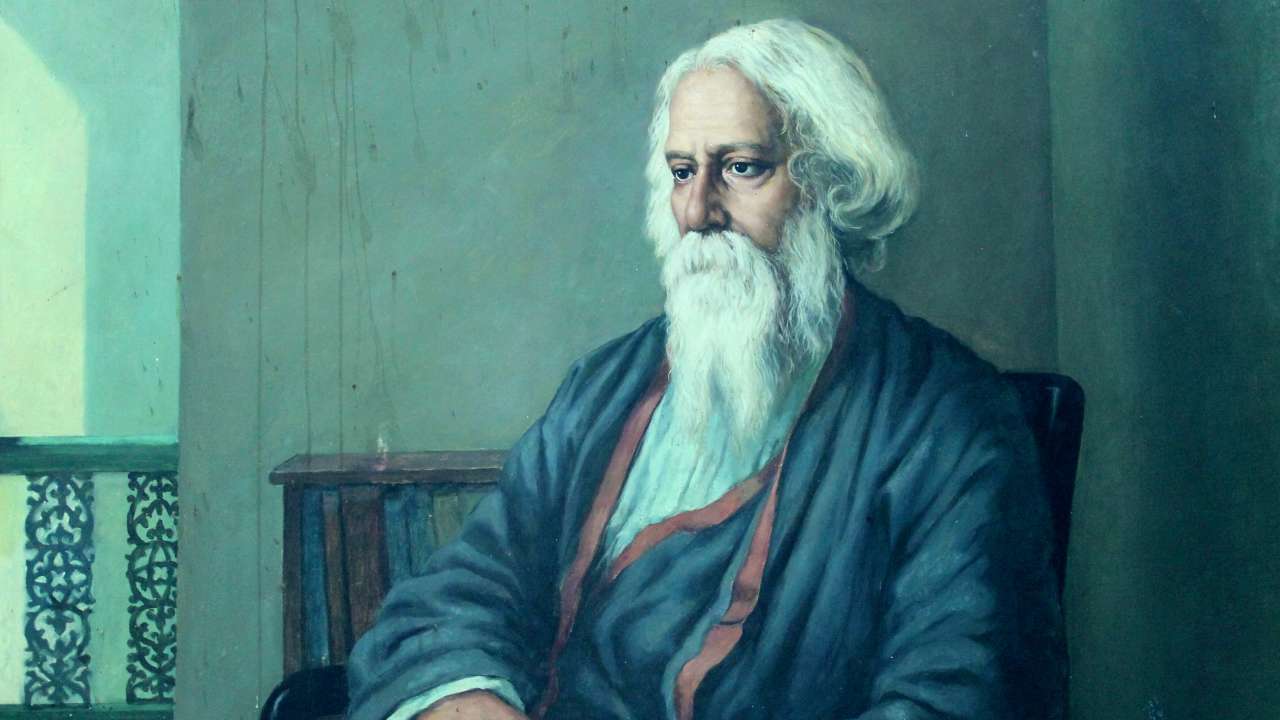
Where the mind is without fear - Rabindranath Tagore

Gitanjali -
By Rabindranath Tagore

Where the mind is without fear and the head is held high;
Where knowledge is free;
Where the world has not been broken up into fragments by narrow domestic walls;
Where words come out from the depth of truth;
Where tireless striving stretches its arms towards perfection;
Where the clear stream of reason has not lost its way into the dreary desert sand of dead habit;
Where the mind is led forward by thee into ever-widening thought and action
Into that heaven of freedom, my Father, let my country awake.

----------------------------------------------------
जहाँ ह्रदय भय रहित होता हो और सिर हमेशा ऊँचा रहता हो ;
जहां ज्ञान निःशुल्क हो;
जहां संकीर्ण घरेलू दीवारों द्वारा दुनिया को टुकड़ों में नहीं तोड़ा गया हो ;
जहां सत्य की गहराई से शब्द निकलते हो ;
जहां पूर्णता को हासिल करने का प्रयास हमेशा जारी हो ;
जहां चेतनता (चैतन्य) की स्पष्ट धारा मृत आदतों के निर्जन रेगिस्तान में अपना रास्ता नहीं खोती हो ;
जहां मन, विचारधारा और क्रियाकल्प आपके (ईश्वर के) द्वारा संचारित हो -
हे परमपिता परमेश्वर , स्वतंत्रता के उस चरम सीमा में मेरे देश को ले चलो!


Friday, February 19, 2021

William Blake - Morning

 Morning

~ William Blake

To find the Western path
Right thro the Gates of Wrath
I urge my way
Sweet Mercy leads me on
With soft repentant moan
I see the break of day
The war of swords & spears
Melted by dewy tears
Exhales on high
The Sun is freed from fears
And with soft grateful tears
Ascends the sky
---------------------------
Interpretation::
When we forgive from our hearts
(The Sun is freed from fears)
At the Agnya Chakra level,
Suppressed by Ego & Superego
Creating futile wars, blood-shed and tears
Only Forgiveness is the weapon
through which the soul can ascend towards its ultimate destination
(Ascends the sky)


William Blake - God Appears & God is Light

 “God Appears & God is Light

To those poor Souls who dwell in Night
But does a Human Form Display
To those who Dwell in Realms of day”


William Blake, Auguries of Innocence
-------------------------------
Interpretation:

The souls who do not believe in the existence of God, are poor souls living in the darkness of ignorance - but still they survive and exist as the ever compassionate God shows Himself to them as Light. But to those who believe in HIM, to those pure and innocent souls, He even shows Himself (Herself) in the human form!

Augury: a sign of what will happen in the future; an omen.

It is the innocent and the pure who will get their access into the Kingdom of God.


Thursday, February 18, 2021

William Blake's illustration of Dante’s Divine Comedy

 William Blake's illustration of Dante’s Divine Comedy :

"Beatrice addressing Dante from the Car."

Shri Mataji commented this picture saying "That's just how it is". Although some figures are quite obvious, the Queen of Sahasrara, the Kundalini in the middle, Dante on the right stretching his hands to feel the vibrations, Shri Mataji identified other deities in the picture: Garuda, Hanuman, Bhairawa and Christ. I let you find them.


My interpretations -

Also the ladies could be Ida and Pingala. Sushumna directing to path to take - middle path! The fish-eyes could be the strands of rising Kundalini!

William Blake - poet, painter, and printmaker

William Blake (28 November 1757 – 12 August 1827) was an English poet, painter, and printmaker. Largely unrecognised during his lifetime, Blake is now considered a seminal figure in the history of the poetry and visual arts of the Romantic Age. What he called his prophetic works were said by 20th-century critic Northrop Frye to form "what is in proportion to its merits the least read body of poetry in the English language".

His visual artistry led 21st-century critic Jonathan Jones to proclaim him "far and away the greatest artist Britain has ever produced".

In 2002, Blake was placed at number 38 in the BBC's poll of the 100 Greatest Britons. While he lived in London his entire life, except for three years spent in Felpham, he produced a diverse and symbolically rich œuvre, which embraced the imagination as "the body of God" or "human existence itself".


Although Blake was considered mad by contemporaries for his idiosyncratic views, he is held in high regard by later critics for his expressiveness and creativity, and for the philosophical and mystical undercurrents within his work.


 His paintings and poetry have been characterised as part of the Romantic movement and as "Pre-Romantic".

A committed Christian who was hostile to the Church of England (indeed, to almost all forms of organised religion), Blake was influenced by the ideals and ambitions of the French and American revolutions.

 Though later he rejected many of these political beliefs, he maintained an amiable relationship with the political activist Thomas Paine; he was also influenced by thinkers such as Emanuel Swedenborg.

Despite these known influences, the singularity of Blake's work makes him difficult to classify. The 19th-century scholar William Michael Rossetti characterised him as a "glorious luminary", and "a man not forestalled by predecessors, nor to be classed with contemporaries, nor to be replaced by known or readily surmisable successors"

Extracted - https://en.wikipedia.org/wiki/William_Blake

GO NOT TO THE TEMPLE - Rabindranath Tagore


 GO NOT TO THE TEMPLE TO PUT FLOWERS UPON THE FEET OF GOD,

FIRST FILL YOUR OWN HOUSE WITH THE FRAGRANCE OF LOVE....

GO NOT TO THE TEMPLE TO LIGHT CANDLES BEFORE THE ALTAR OF GOD,
FIRST REMOVE THE DARKNESS OF SIN FROM YOUR OWN HEART.....

GO NOT TO THE TEMPLE TO BOW DOWN YOUR HEAD IN PRAYER,
FIRST LEARN TO BOW IN HUMILITY BEFORE YOUR FELLOW MEN.....

GO NOT TO THE TEMPLE TO PRAY ON BENDED KNEES,
FIRST BEND DOWN TO LIFT SOMEONE WHO IS DOWNTRODDEN. ....

GO NOT TO THE TEMPLE TO ASK FOR FORGIVENESS FOR YOUR SINS,
FIRST FORGIVE FROM YOUR HEART THOSE WHO HAVE SINNED AGAINST YOU.

-By. Rabindranath Tagore


मंदिर न जाओ - रविंद्रनाथ टैगोर

ईश्वर के चरणों में फूल चढ़ाने के लिए मंदिर न जाएं,

पहले अपने घरों को प्रेम और सदभावना की खुशबू से भरें

ईश्वर की वेदी के सामने मोमबत्तियां जलाने के लिए मंदिर न जाएं,

पहले अपने दिलों से पाप का अंधेरा हटाएं

प्रार्थना में अपना सिर झुकाने के लिए मंदिर न जाएं,

पहले अपने साथियों व सहयोगियों के सामने विनम्रता से झुकना सीखें

घुटनों के बल गिरकर प्रार्थना करने के लिए मंदिर न जाएं,

सबसे पहले झुके हुए दलित व् गरीबों को उठाएं।

अपने पापों के लिए क्षमा मांगने के लिए मंदिर न जाएं,

पहले अपने दिल से उन लोगों को क्षमा करें जिन्होंने आपके साथ बुरा किया हो !

Translated to Hindi by Aparna Gangopadhyay, Sahaja Yogini


Rabindranath Tagore - Bengali poet, writer, composer, philosopher and painter.

 Rabindranath Tagore (7 May 1861 – 7 August 1941)

Rabindranath Tagore FRAS was a Bengali poet, visual artist, playwright, novelist, writer, composer, philosopher and painter. He reshaped Bengali literature and music, as well as Indian art with Contextual Modernism in the late 19th and early 20th centuries.

(from Wikipedia)


He became Asia's first Nobel laureate when he won the 1913 Nobel Prize in Literature.

A Pirali Brahmin from Calcutta, Bengal, Tagore first wrote poems at the age of eight. At the age of sixteen, he published his first substantial poetry under the pseudonym Bhanushingho ("Sun Lion") and wrote his first short stories and dramas in 1877.


In later life Tagore protested strongly against the British Raj and gave his support to the Indian Independence Movement. 

Tagore's life work endures, in the form of his poetry and the institution he founded, Visva-Bharati University.

Tagore wrote novels, short stories, songs, dance-dramas, and essays on political and personal topics. Gitanjali (Song Offerings), Gora (Fair-Faced), and Ghare-Baire (The Home and the World) are among his best-known works. 

His verse, short stories, and novels, which often exhibited rhythmic lyricism, colloquial language, meditative naturalism, and philosophical contemplation, received worldwide acclaim.

Tagore was also a cultural reformer and polymath who modernised Bengali art by rejecting strictures binding it to classical Indian forms.

 Two songs from his canon are now the national anthems of Bangladesh and India: the Amar Shonar Bangla and the Jana Gana Mana respectively.